Telangana EV Charging Highways Rank: Infrastructure Expansion Snapshot
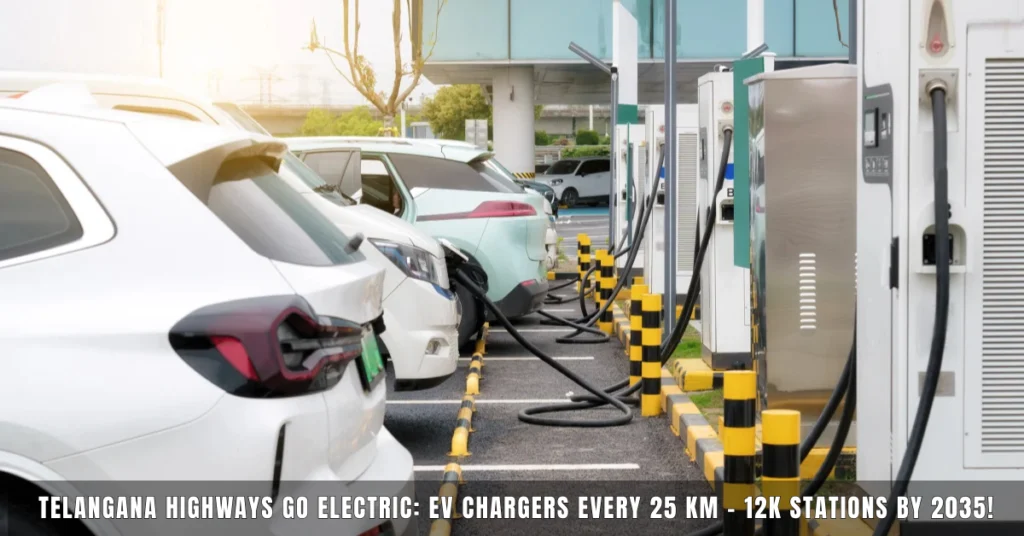
- Highway Rollout: Public EVCS every 25–30 km on national & state highways; sites at dhabas, restaurants, sub-stations (<500 m), and govt land.
- Urban Push: Tier-1/2 cities get chargers at offices, hospitals, schools, railway stations & public spots.
- Current Stats: 1,030+ stations statewide (600 in Hyderabad); 1,500+ private applications pending approval.
- Growth Targets: Scale to 6,000 public EVCS by 2030 and 12,000 by 2035 under EV Policy 2020–2030.
- Demand Surge: Energy use up 4x—from 2.60 MU (Sep 2024) to 10.15 MU (Sep 2025); TGSRTC buses lead at 7.81 MU.
- Costs & Subsidies: 60 kW charger setup ~₹15 lakh (₹7L hardware + ₹7L infra); the PM E-Drive scheme aids funding.
- App Incoming: Unified mobile app for statewide station locator & trip planning—launching soon.
- Policy Backing: Aligns with Clean Energy Policy 2025; the PPP model drives private involvement.
Telangana Accelerates EV Revolution: Chargers Blanket Highways & Cities
The southern state of Telangana is revving up its electric mobility engine like never before, with the Telangana Renewable Energy Development Corporation (TGREDCO) unveiling an ambitious blueprint to dot highways with public EV charging stations (EVCS) every 25–30 kilometers. This highway-centric push, detailed in recent announcements and covered extensively by The Hindu on November 15, 2025, isn’t just about plugging in—it’s a full-throttle strategy to slash range anxiety, supercharge adoption, and cement Telangana as India’s green transport frontrunner. By weaving chargers into the fabric of national and state roadways, TGREDCO aims to make long-haul EV trips as seamless as a quick coffee stop.
Prime Locations Locked In: Dhabas to Govt Plots
No more frantic battery hunts mid-journey. TGREDCO is scouting high-traffic hotspots: bustling dhabas and restaurants for that pit-stop vibe, spots within 500 meters of electrical substations for easy grid tie-ins, and swathes of government-owned land hugging the asphalt. This smart siting minimizes costs while maximizing accessibility—think pulling off NH-44 for a thali and a top-up in one go. As per TGREDCO Managing Director V. Anila, “These placements will ensure EV drivers never stray more than 15–20 minutes from a charger, turning skeptics into converts.”
Urban dwellers aren’t left behind. In Tier-1 hubs like Hyderabad and Tier-2 gems such as Warangal and Karimnagar, chargers will sprout at government offices for official fleets, hospitals for on-call saviors, schools for parent shuttles, and railway stations for intermodal hops. This multi-pronged rollout, blending highways with city cores, is projected to ignite a virtuous cycle: More stations mean bolder EV buys, which in turn demand even denser networks.
From 1,000 to 12,000: The Explosive Growth Trajectory
Telangana’s EV infra is already humming with over 1,030 charging stations statewide as of November 2025, with Hyderabad alone boasting nearly 600. But that’s just the appetizer. TGREDCO has fielded 1,500 applications from eager private players under a public-private partnership (PPP) model, though final nods for city and highway spots are pending. The vision? To balloon to 6,000 public EVCS by 2030 and a staggering 12,000 by 2035, all anchored in the state’s forward-thinking EV & Energy Storage Policy (2020–2030) and the freshly minted Clean Energy Policy (2025).
This isn’t pie-in-the-sky; it’s data-backed ambition. Charging energy consumption has quadrupled, leaping from a modest 2.60 million units (MU) in September 2024 to a robust 10.15 MU last month. The Telangana State Road Transport Corporation (TGSRTC) dominates the draw, guzzling 7.81 MU to juice its expanding electric bus armada (though those stations are bus-exclusive for now). Private cars, two-wheelers, and cargo EVs are nipping at their heels, signaling a tipping point where EVs aren’t novelties—they’re necessities.
Crunching the Numbers: Costs, Subsidies, and Setup Realities
Dream big, but build smart. Each EVCS demands about 650 sq. ft. of real estate, split between the charger itself and upstream guts like transformers, cables, AC panels, and civil digs. A zippy 60 kW fast charger? Ballpark ₹15 lakh total – ₹7 lakh for the hardware wizardry and another ₹7 lakh for the behind-the-scenes plumbing. The good news? The central government’s PM E-Drive scheme dishes out subsidies to sweeten the pot, making PPPs a no-brainer for entrepreneurs.
Private interest is electric: Those 1,500 bids reflect a gold rush, with TGREDCO fast-tracking approvals to hit milestones. Challenges? Securing land in land-scarce urban belts and syncing with overburdened grids, but with solar hybrids and smart metering in the mix, solutions are charging ahead.
App Alert: One Tap to Zero Anxiety
Range jitters? Not for long. Telangana’s cooking up a game-changer: A unified mobile app that maps every public charger statewide, dishing real-time availability, route-optimized stops, and even seamless payment. Launching imminently, it’ll be the EV owner’s Swiss Army knife, plotting Hyderabad-to-Vijayawada jaunts with detours for dosas and deltas. As Anila puts it, “This app will boost public confidence, making EVs as intuitive as Uber.”
The Bigger Green Picture: Why This Matters Now
Telangana’s highway blitz aligns with national norms (every 25 km on expressways) but amps it up with state-specific flair; think integrated solar canopies at dhabas for off-grid resilience. It’s a boon for the state’s 1 lakh+ EVs (and counting), from Tata Nexons zipping through suburbs to electric autos thrumming through cities. Broader wins? Job creation in green tech, slashed emissions (target: 30% EV penetration by 2030), and a magnet for investments like VinFast’s rumored factories.
In a nation where EV sales hit 2 million in FY25, Telangana’s network could make it the southern gateway to sustainable drives. As consumption soars and subsidies flow, this 25–30 km grid isn’t just infrastructure; it’s the spark igniting India’s electric dawn.
Source: entrepreneurindia.com
Read more about EV Car News
Also Read
- MG Windsor Big Discounts Jan 2026: First-Ever Offers Make It Cheaper Than Launch Price
- JSW Motors To Enter Passenger Car Space In June With Rs 45 Lakh Plug-In Hybrid SUV
- Maruti Suzuki Second Car Plant Gujarat Investment: ₹4,960 Crore for 10 Lakh Unit Capacity

- India’s EV Sales Reach 2.3 Million Units in 2025, 8 Percent of New Vehicles: Strong Growth Led by Two-Wheelers
- VinFast Off to a Fast Start, Crosses 1k EV Sales in India: Milestone in Just Four Months
- What Happens To EV Battery After End-Of-Life?