Image source: asia.nikkei.com
SK On Ford US Battery Joint Venture End: Overview
- SK On (SK Innovation subsidiary) and Ford Motor mutually agree to dissolve their BlueOval SK joint venture for US EV battery plants, announced December 11, 2025.
- Ford takes full ownership of Kentucky plants (Glendale, $5.8 billion investment; one operational, one under construction).
- SK On assumes control of the Tennessee plant (Stanton, $5.6 billion; production timeline flexible due to transition).
- Original 2022 deal: $11.4 billion for three factories; split expected in Q1 2026, maintaining strategic supply partnership.
- Driven by slowing EV demand, US subsidy losses ($7,500 tax credit ended Sept 30, 2025), and SK On’s Q3 loss doubling to $84.72 million, they are pivoting to energy storage systems (ESS).
SK On and Ford Call It Quits on Massive US Battery JV: A Strategic Split in the EV Chill
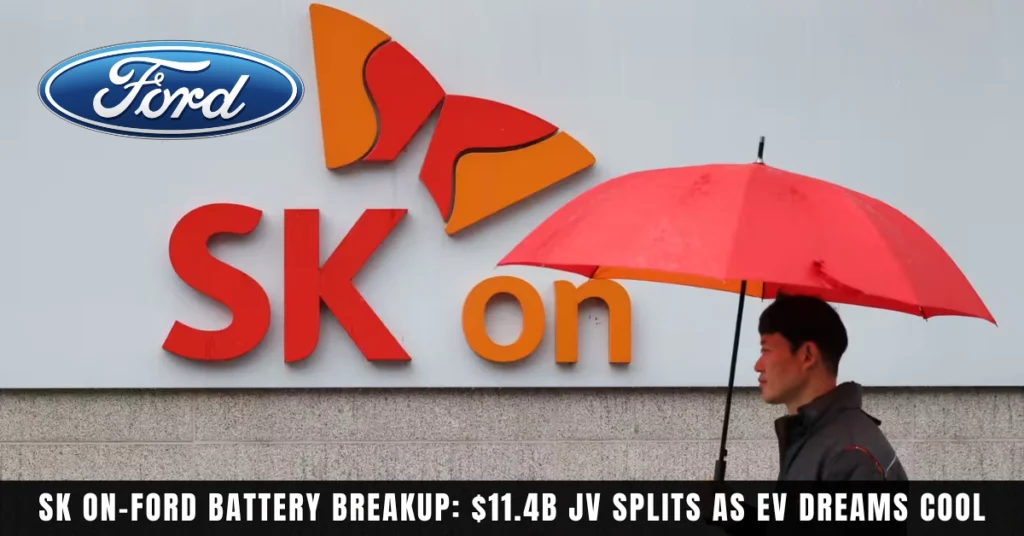
In a seismic shift for America’s electric vehicle supply chain, South Korean battery powerhouse SK On revealed on December 11, 2025, that it is pulling the plug on its high-stakes joint venture with Ford Motor Co., effectively ending the BlueOval SK partnership after just three years. What began as a blockbuster $11.4 billion bet on powering Ford’s F-Series EVs with homegrown batteries is now a clean divorce: Ford scoops up the twin Kentucky facilities outright, while SK On claims sole ownership of the sprawling Tennessee site. This breakup, set to finalize in Q1 2026, comes as the EV boom turns bust, with plunging demand and vanishing subsidies forcing battery makers to rethink their North American playbook.
The timing is brutal. Ford CEO Jim Farley warned in September that EV sales could crater 50% after the $7,500 federal tax credit vanishes on September 30, 2025, under new Trump policies. SK On, already bleeding red ink with a Q3 operating loss nearly doubling to 124.8 billion won ($84.72 million), sees the split as a lifeline—slashing debt, trimming fixed costs, and freeing resources to chase sunnier skies like energy storage systems for data centers and grids. For Ford, it means tighter control over its battery destiny amid a market where hybrids outsell pure EVs 2-to-1. This isn’t acrimony; it’s adaptation in an industry where yesterday’s goldmine is today’s write-off.
The Split Deal: Assets Divided, Partnership Persists
| Facility | New Owner/Operator | Investment | Status | Notes |
|---|---|---|---|---|
| Kentucky (Glendale) | Ford subsidiary | $5.8 billion | One plant operational; second under construction | Full Ford control; powers F-150 Lightning |
| Tennessee (Stanton) | SK On | $5.6 billion | Under construction | Flexible start date; SK On to supply Ford and others |
The original 2022 pact pooled $11.4 billion to erect three gigafactories—two in Kentucky’s Glendale and one mega-site in Tennessee’s Stanton (BlueOval City)—aiming for 129 GWh annual output by 2030. Now, with EV volumes lagging (Ford’s Q3 EV sales down 30% YoY), the JV’s shared burdens outweigh benefits. SK On keeps a “strategic partnership” lifeline, continuing battery flows to Ford from Tennessee while eyeing multi-customer deals. Ford, meanwhile, dodges JV overheads, focusing on its $30 billion EV war chest amid subsidy cuts that could slash incentives further under Trump.
Why now? EV Winter Bites Hard
The breakup screams market reality. Global EV sales growth slowed to 20% in 2025 (vs. 40% in 2024), hammered by high prices ($50K+ average), charging woes, and policy U-turns. In the US, the IRA’s $7,500 credit expiry gutted affordability, with Ford’s EV share dipping to 7% from 10%. SK On, a supplier to Hyundai, Kia, and Ford, shipped 20% fewer cells in Q3, ballooning losses as factories idled.
Enter energy storage: SK On’s September pact with Flatiron Energy for LFP batteries targets the ESS boom (projected $100 billion market by 2030). Repurposing EV lines for grid-scale packs—same chemistry, different scale—hedges bets. Rivals like LG Energy Solution and Samsung SDI are doing the same, converting 20-30% of capacity to ESS amid EV frost.
Ford’s side? CEO Farley’s October forecast of a 50% EV sales plunge post-subsidy rings true, with Q4 orders already softening. The split lets Ford streamline, perhaps leasing excess capacity or pivoting to hybrids where it leads (Mach-E sales up 15% YoY).
Broader Ripples: Battery Industry’s Wake-Up Call
This JV implosion echoes a sector in flux. South Korean giants, once EV darlings, face $10 billion+ in cumulative losses since 2023. Chinese rivals (CATL, BYD) dominate with 60% global share and dirt-cheap LFP, forcing Koreans to specialize in premium NCM for luxury EVs. US loans? The DOE’s $9.2 billion to BlueOval SK gets reworked, potentially with clawbacks under Trump scrutiny.
For consumers, it means a steadier supply (factories stay open) but higher prices in the short term as subsidies fade. Long-term? ESS pivot could stabilize grids for renewables, indirectly boosting EVs via cheaper power.
Analysts like AutoForecast’s Conrad Layson call SK On “most financially stretched,” with H1 2025 losses at $129.9 million. Morningstar’s David Whiston speculates differing visions: Ford eyes hybrids, and SK chases ESS.
The Road Ahead: Divorce Papers to New Alliances
Q1 2026 closure means minimal disruption—Kentucky ramps for F-150 Lightning, Tennessee flexes for SK’s ESS pivot. SK On vows “strategic realignment” for agility, while Ford hunkers down for subsidy wars. In a cold EV market, this split is survival: better solo than sinking together.
Source: republicworld.com
Read more about EV Car News
Also Read
- MG Windsor Big Discounts Jan 2026: First-Ever Offers Make It Cheaper Than Launch Price
- JSW Motors To Enter Passenger Car Space In June With Rs 45 Lakh Plug-In Hybrid SUV
- Maruti Suzuki Second Car Plant Gujarat Investment: ₹4,960 Crore for 10 Lakh Unit Capacity
- India’s EV Sales Reach 2.3 Million Units in 2025, 8 Percent of New Vehicles: Strong Growth Led by Two-Wheelers
- VinFast Off to a Fast Start, Crosses 1k EV Sales in India: Milestone in Just Four Months
- What Happens To EV Battery After End-Of-Life?