India Toyota Mirai Hydrogen FCEV Pilot Project: Overview
- India kicks off a landmark pilot project to test the Toyota Mirai hydrogen fuel cell electric vehicle under actual Indian road conditions.
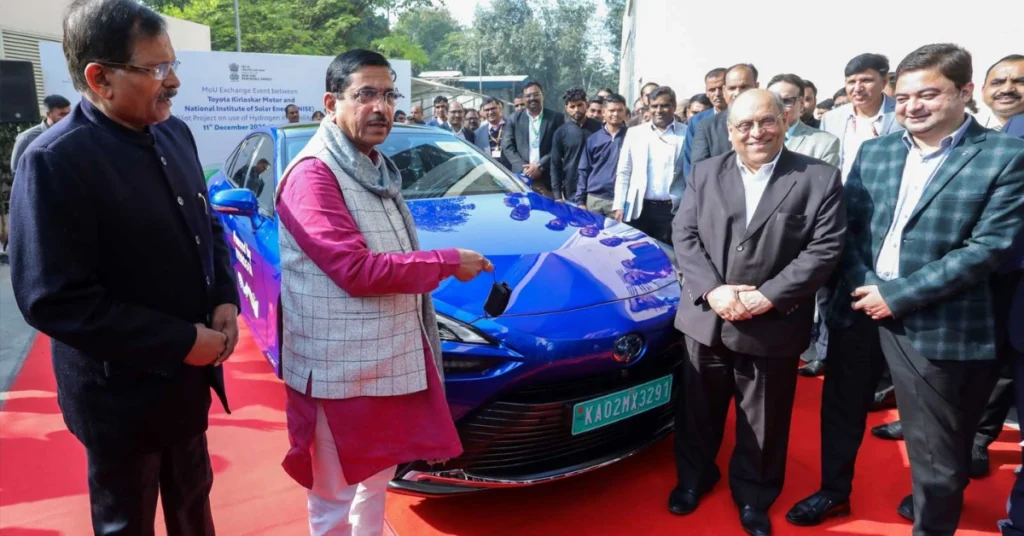
- Launched on December 12, 2025, by Union Minister Pralhad Joshi, the vehicle was handed over to the National Institute of Solar Energy (NISE) for 24 months of field trials.
- Mirai will be evaluated across diverse terrains, climates, and traffic scenarios to generate data for policy and future scaling.
- Zero tailpipe emissions (only water vapor), a 650 km range, and refueling in under 5 minutes.
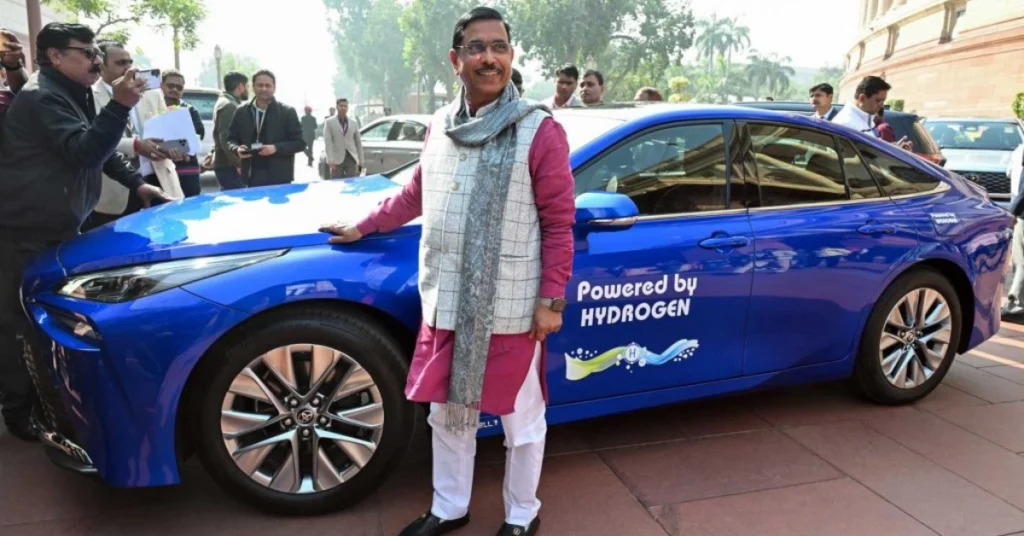
- Minister Joshi drove the Mirai to Parliament, symbolising India’s shift from policy to on-the-ground hydrogen experimentation.
India Accelerates Hydrogen Mobility: Toyota Mirai Pilot Project Takes Off
India has officially entered the hydrogen era on wheels. On December 12, 2025, Union Minister for New & Renewable Energy Pralhad Joshi flagged off a groundbreaking pilot project by handing over a Toyota Mirai hydrogen fuel cell electric vehicle (FCEV to the National Institute of Solar Energy (NISE). This marks the country’s first structured, long-term real-world testing of a production hydrogen car, moving the National Green Hydrogen Mission from boardrooms to actual roads.
The second-generation Mirai, powered solely by hydrogen, produces electricity onboard through an electrochemical reaction between hydrogen and oxygen, emitting nothing but pure water. With an impressive 650 km range and refueling time of under five minutes, it offers the convenience of conventional cars while delivering zero-emission performance. Over the next two years, NISE will push the Mirai through India’s toughest conditions: scorching Rajasthan summers, freezing Himalayan winters, monsoon-soaked highways, and bumper-to-bumper city traffic. Every kilometer will generate priceless data on durability, efficiency, refueling logistics, and safety in Indian scenarios.
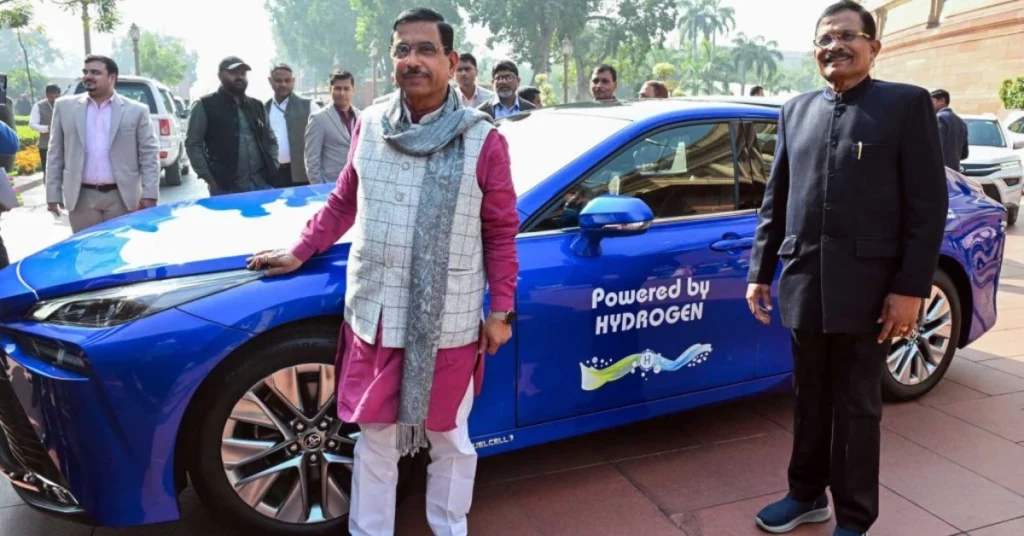
Minister Joshi called it “a key milestone in advancing clean transport solutions” and emphasized that green hydrogen will play a central role in India’s long-term energy independence and net-zero journey. After the handover ceremony, he personally drove the Mirai from the venue straight to Parliament, turning the green-certified building into a fitting backdrop for showcasing tomorrow’s mobility today.
Voices from the Launch
- Pralhad Joshi, Union Minister:
“Green hydrogen is emerging as a major component of global clean energy systems. The induction of the Toyota Mirai marks growing collaboration between government, research institutions, and industry in advancing fuel cell technologies.” - Shripad Yesso Naik, Minister of State:
“This pilot reflects India’s transition from policy announcements to on-ground experimentation under the National Green Hydrogen Mission. Such trials will support commercialising hydrogen-based transport and improving urban air quality.” - Toyota Kirloskar Motor statement:
“The partnership reinforces our support for India’s hydrogen mission and efforts toward achieving net-zero emissions.”
Why This Pilot Matters More Than Ever
| Range + Speed
650 km on a single tank and 5-minute refuels solve the two biggest complaints against battery EVs: long charging times and range anxiety on highways.
Zero Emissions, Real-World Ready
Unlike battery EVs that still rely on grid electricity (often coal-based in India), the Mirai’s only byproduct is water, making it truly zero-emission when fueled with green hydrogen.
Data for Policy
Two years of Indian-specific testing will answer critical questions:
- How does the fuel cell handle dust, heat, and humidity?
- What infrastructure gaps exist for hydrogen storage and transport?
- How cost-effective is FCEV ownership versus diesel, petrol, CNG, and battery EVs?
These findings will directly feed into the National Green Hydrogen Mission (₹19,744 crore outlay) and shape future incentives, refueling networks, and potential local manufacturing of FCEVs.
The Toyota Mirai in Numbers
| Specification | Details |
|---|---|
| Powertrain | Hydrogen fuel cell + electric motor |
| Range (claimed) | ~650 km |
| Refuelling time | Under 5 minutes |
| Emissions | Only water vapour |
| Acceleration 0-100 km/h | ~9 seconds |
| Top speed | 175 km/h |
Bigger Picture: Hydrogen’s Role in India’s Energy Mix
While battery EVs dominate headlines, hydrogen FCEVs are ideal for:
- Heavy-duty long-haul trucks and buses
- Regions with limited by grid capacity
- Fleets needing quick refuelling (taxis, logistics)
With India targeting 5 million tonnes of green hydrogen production by 2030, projects like the Mirai pilot are crucial stepping stones toward building refueling corridors, storage solutions, and cost-competitive green hydrogen supply chains.
The Road Ahead
The Mirai will now begin its marathon across India, logging thousands of kilometers while scientists at NISE monitor every parameter. The data collected over 2026-2027 will decide whether hydrogen cars move from pilot curiosity to mainstream reality on Indian roads.
One thing is already clear: the future of clean mobility is no longer just electric. It is electric AND hydrogen. And with the Mirai now officially on Indian soil, that future just got a lot closer.
Source: ddnews.gov.in
Read more about Upcoming Cars
Aslo Read
- Genesis GV60 Magma Debut: First High-Performance Electric Vehicle Revealed at CES 2026
- Mazda CX-6e Electric SUV Debuts at Brussels Motor Show: Premium Compact EV Revealed
- BMW to Launch Three New EV Models in India to Boost Sales: Targeting 25% EV Share in 2026
- Toyota Urban Cruiser EV India Launch On January 19th: Specs, Features, and Expected Pricing
- Renault Twingo E-Tech Electric Debuts at Brussels Motor Show: €19,490 Affordable City EV
- Mahindra XUV 3XO EV Launched At Rs 13.89 Lakh: Full Specs, Features, and Segment-Beating Performance
Catchy Title for the Image: “Toyota Mirai Hits Indian Roads: Hydrogen Revolution Starts Now”