Pralhad Joshi and Nitin Gadkari Take Joint Ride: Overview
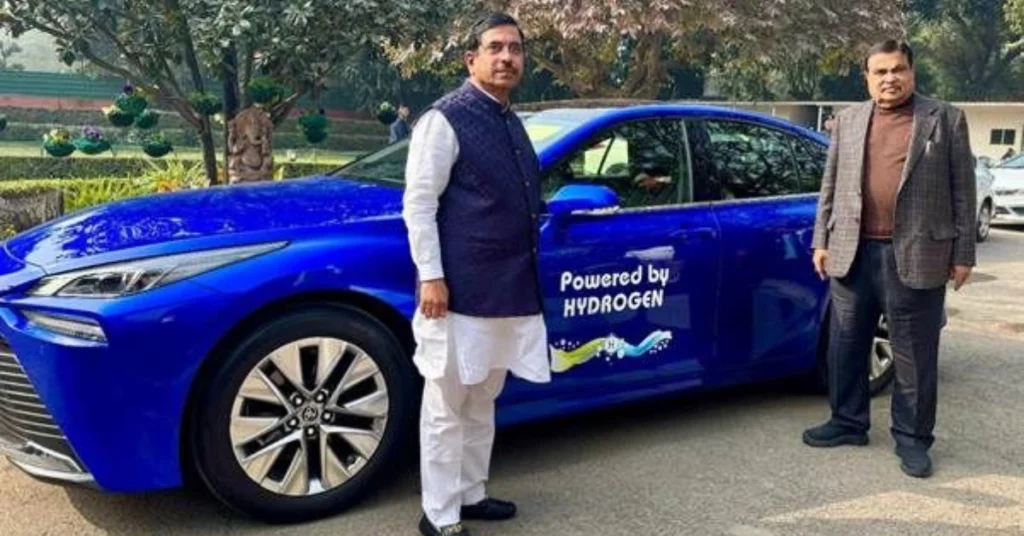
- Union Ministers Pralhad Joshi (New and Renewable Energy) and Nitin Gadkari (Road Transport and Highways) experienced a joint ride in the Toyota Mirai hydrogen fuel-cell electric vehicle (FCEV).
- The demonstration highlights India’s push for hydrogen as a clean fuel alternative to battery EVs.
- Mirai (second-generation) produces electricity via hydrogen-oxygen reaction, emitting only water vapour.
- The event underscores the government’s focus on diversifying green transport beyond lithium-ion batteries.
Ministers Joshi and Gadkari Ride Toyota Mirai: A Symbolic Step Toward Hydrogen-Powered Future
In a powerful demonstration of India’s commitment to diversified clean mobility solutions, Union Minister for New and Renewable Energy Pralhad Joshi and Union Minister for Road Transport and Highways Nitin Gadkari took a joint ride in the advanced Toyota Mirai hydrogen fuel-cell electric vehicle (FCEV) on January 8, 2026. The second-generation Mirai, known for its innovative technology that generates electricity through a chemical reaction between hydrogen and oxygen—producing only pure water vapour as exhaust—served as a rolling showcase of hydrogen’s potential to revolutionise transportation.
The ministers’ ride symbolised high-level governmental endorsement for exploring hydrogen alongside battery electric vehicles in the nation’s green mobility roadmap. As India grapples with battery material constraints, charging infrastructure challenges, and the need for energy independence, hydrogen FCEVs like the Mirai offer a complementary path: rapid refueling (similar to petrol/diesel), longer ranges, and zero tailpipe emissions.
Minister Gadkari, a longtime advocate for alternative fuels including hydrogen, biofuels, and CNG, has repeatedly emphasised diversifying beyond single-technology dependence. The joint experience with Minister Joshi—responsible for renewable energy, including green hydrogen—highlighted inter-ministerial synergy in pushing sustainable transport solutions.
Toyota Mirai: Key Technology Highlights
The Mirai (“future” in Japanese) represents cutting-edge FCEV engineering:
| Aspect | Details |
|---|---|
| Power Source | Hydrogen fuel cell stack |
| Emission | Only water vapour |
| Refuelling Time | 3-5 minutes (similar to conventional fuels) |
| Range | Up to 650 km (depending on conditions) |
| Performance | Smooth, quiet drive with instant torque |
The vehicle combines a fuel cell system with a small battery for hybrid-like efficiency, making it suitable for long-distance and heavy-duty applications where pure battery EVs face limitations.
Why Hydrogen Matters for India’s Mobility Goals
The ministers’ ride underscores strategic advantages of hydrogen:
- Energy Security: Utilises green hydrogen produced from renewables, reducing import dependence.
- Rapid Refuelling: Addresses EV charging time concerns.
- Heavy-Duty Suitability: Ideal for trucks and buses—sectors harder to electrify with batteries.
- Complementary Role: Works alongside battery EVs for comprehensive decarbonisation.
India’s National Green Hydrogen Mission targets 5 million tonnes of annual production by 2030, with transport as a key demand sector.
Government’s Multi-Fuel Approach
Minister Gadkari’s vision encompasses biofuels, CNG, LNG, and hydrogen—avoiding over-reliance on any single technology. The Mirai demonstration aligns with pilots for hydrogen buses and trucks, plus investments in refueling infrastructure.
Collaboration between the New & Renewable Energy and Road Transport ministries signals a coordinated policy push.
Challenges and Path Forward
While promising, hydrogen adoption faces hurdles:
- High initial vehicle costs.
- Limited refueling stations.
- Green hydrogen production scaling.
The ministerial ride serves as visible encouragement for private investment and public acceptance.
The Bigger Picture: Diversified Clean Mobility
As battery EVs dominate headlines, the Mirai experience reminds stakeholders that India’s transition requires multiple pathways. Hydrogen FCEVs offer unique benefits for specific use cases, contributing to reduced emissions, job creation in new energy sectors, and technological self-reliance.
With ministers literally riding the technology, hydrogen’s role in India’s sustainable transport narrative gains prominent momentum—a clear signal that the future of mobility will be multi-fuel and inclusive.
Source: indianchemicalnews.com
Read more about Ev Car News
Also Read
- MG Windsor Big Discounts Jan 2026: First-Ever Offers Make It Cheaper Than Launch Price
- JSW Motors To Enter Passenger Car Space In June With Rs 45 Lakh Plug-In Hybrid SUV
- Maruti Suzuki Second Car Plant Gujarat Investment: ₹4,960 Crore for 10 Lakh Unit Capacity
- India’s EV Sales Reach 2.3 Million Units in 2025, 8 Percent of New Vehicles: Strong Growth Led by Two-Wheelers
- VinFast Off to a Fast Start, Crosses 1k EV Sales in India: Milestone in Just Four Months
- What Happens To EV Battery After End-Of-Life?