India Rare Earth Push 2025: All the Important Details
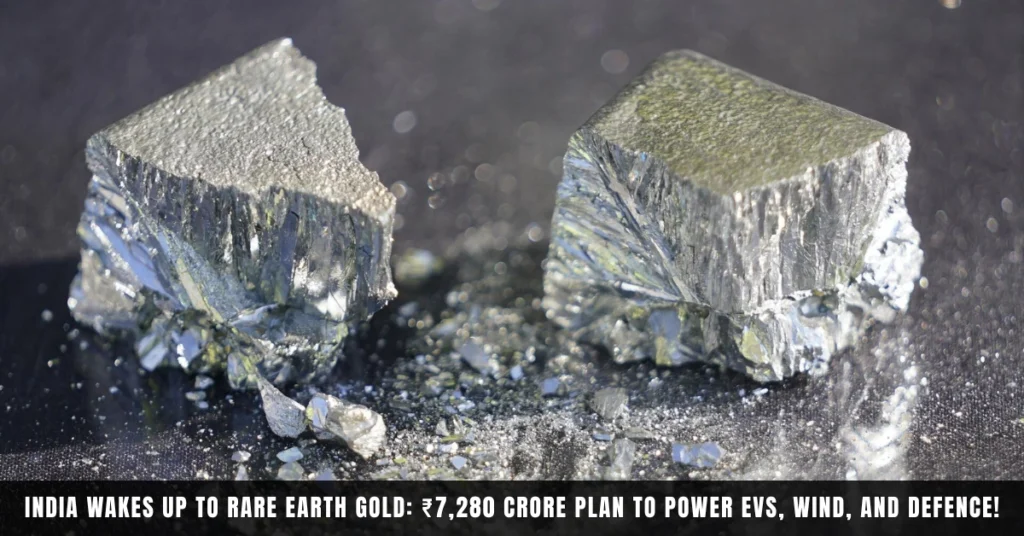
- Seventeen special metals called rare earth elements make phones vibrate, electric cars run silently, wind turbines spin, screens glow bright, and missiles fly straight.
- India has some of the richest monazite beach sands in the world along the coasts of Odisha, Kerala, Tamil Nadu, Andhra Pradesh, and West Bengal.
- On November 27, 2025, the Union Cabinet approved a massive ₹7,280 crore Production-Linked Incentive (PLI) scheme.
- Companies that build factories to produce neodymium-iron-boron (NdFeB) permanent magnets will get direct cash rewards—the first slice is ₹350 crore.
- These magnets are the strongest ever made and are needed in every electric motor, wind turbine generator, defence equipment, and smartphone speaker.
- China currently mines 60% of global rare earths and processes almost 90%.
- India, despite having huge deposits, makes only 1% of the world’s rare earth supply.
- New target: Start producing world-class magnets inside India by 2027-28.
- India joined the 14-country Mineral Security Partnership (MSP) in 2023 with USA, Australia, Japan, South Korea, EU, and others to create safe supply chains.
- Australia will send raw concentrate; Indian plants will separate and make finished magnets.
What Exactly Are Rare Earth Elements, and Why Are They So Important?
The Seventeen Hidden Heroes of Modern Life
There are seventeen metals in the rare earth family: scandium, yttrium, and the fifteen lanthanides from lanthanum to lutetium. They are not actually rare in the Earth’s crust—some are more common than copper, but they are never found in big, clean deposits. They hide inside complicated minerals like monazite, bastnäsite, and xenotime. Separating them is slow and expensive and creates toxic and radioactive waste.
Yet every modern gadget needs them:
- Neodymium and a little dysprosium → create the strongest permanent magnets ever invented. One small magnet can lift thousands of times its own weight. These magnets make electric car motors powerful yet light, wind turbines small yet strong, and headphones tiny yet loud.
- Europium and terbium → give bright red and green colors on phone and TV screens.
- Cerium → polishes the glass of every smartphone to perfect smoothness and cleans harmful gases from car exhaust.
- Yttrium → helps make super-strong ceramics for jet engines.
- Samarium, gadolinium, erbium → used in missiles, radar, MRI machines, nuclear reactors, and fiber-optic cables.
Without rare earths, electric cars would weigh twice as much, wind turbines would be huge and costly, phones would be thick bricks, and modern defence systems would simply not work.
The Day China Stopped the World
In 2010, China had a diplomatic fight with Japan. China suddenly cut rare earth exports by 40%. Within weeks, prices jumped 500% to 1000%. Car factories in Japan, Germany, and the USA stopped production because they had no magnets. The whole world realized how dangerous it is to depend on one country.
India’s Long Sleep and Sudden Wake-Up
Rich Beaches, Empty Pockets
For more than fifty years, India quietly exported millions of tonnes of monazite-rich beach sand to other countries. Those countries did the difficult refining work and sold finished magnets back to Indian companies at ten times the price. India earned almost nothing and stayed completely dependent.
The Game-Changing ₹7,280 Crore Decision
On November 27, 2025, everything changed. The Union Cabinet launched one of the biggest industrial pushes in recent times: a ₹7,280 crore Production-Linked Incentive scheme only for high-performance rare earth permanent magnets. Any company that sets up a factory in India to make neodymium-iron-boron magnets will get direct cash from the government for every kilogram produced. The first ₹350 crore is ready to be given out.
This is not just about money. It is about national security, green energy, and future jobs. Electric vehicles, wind and solar power, defence missiles, and new technology industries will all need millions of these magnets every year.
Friends Helping Friends
India is not doing this alone. In 2023, India joined the Mineral Security Partnership—a team of 14 strong countries led by the United States. Members include Australia (third-largest reserves), Japan, South Korea, Canada, and the European Union. Everyone wants supply chains that no single country can block.
Australia and India are already planning joint projects. Australian mines will send concentrated rare earth powder. Indian factories will separate the metals and make finished magnets. First commercial production is expected by 2027-28.
The Challenges India Must Solve
Radioactive Waste and People’s Trust
Monazite sand contains thorium, which is mildly radioactive. In the past, poor mining practices harmed coastal villages and the sea. People in Odisha and Kerala still remember those difficult days. The government now promises world-class, clean plants with zero harmful waste. They must keep every promise and involve local communities from day one.
A Long Road but a Bright Future
For decades India treated rare earths as just another minor mineral. That attitude has ended forever. The new ₹7,280 crore scheme is the loudest signal yet that India is serious about becoming a rare earth superpower.
From the quiet hum of an electric car to the roar of a missile, from the spinning blades of a giant wind turbine to the bright screen in your hand—these seventeen metals are the hidden backbone of the future. India finally decided to turn its golden beach sand into real strategic gold before it is too late.
Source: indiatoday.in
Read more about EV Car News
Also Read
- MG Windsor Big Discounts Jan 2026: First-Ever Offers Make It Cheaper Than Launch Price
- JSW Motors To Enter Passenger Car Space In June With Rs 45 Lakh Plug-In Hybrid SUV

- Maruti Suzuki Second Car Plant Gujarat Investment: ₹4,960 Crore for 10 Lakh Unit Capacity
- India’s EV Sales Reach 2.3 Million Units in 2025, 8 Percent of New Vehicles: Strong Growth Led by Two-Wheelers
- VinFast Off to a Fast Start, Crosses 1k EV Sales in India: Milestone in Just Four Months

- What Happens To EV Battery After End-Of-Life?