Volkswagen India EV Investment Rank: Strategic Reset 2025 Overview
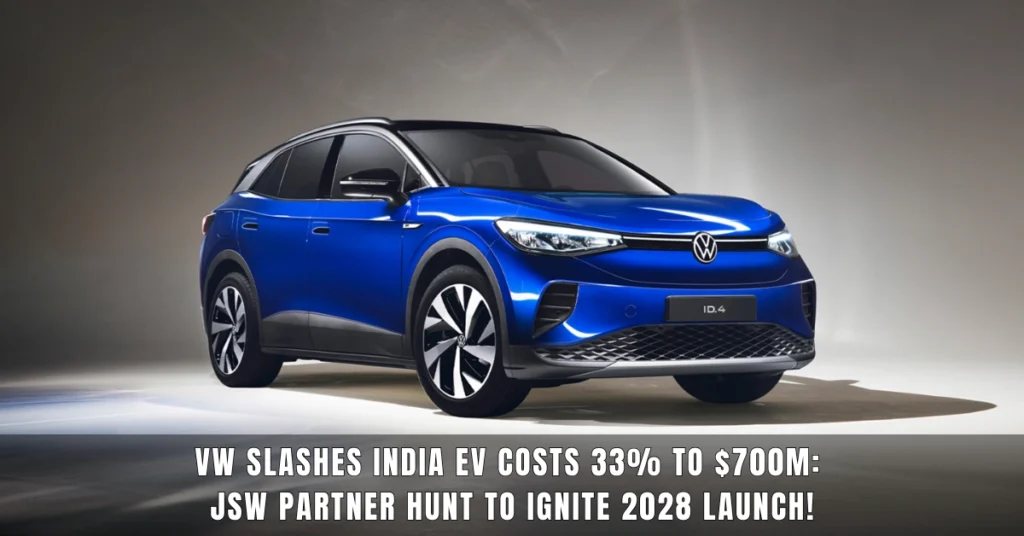
- Cost Trim: The EV platform development budget was cut 33% from $1B to $700M—signaling caution after 20 years of ~2% market share in India.
- Partner Hunt: Talks with JSW Group (SAIC-MG partner) and Indian contract manufacturers; the Mahindra deal collapsed in 2024.
- Launch Timeline: India-specific EVs are eyed for a 2028 debut; short-term imports are possible if the EU-India trade deal unlocks duties.
- Market Pressure: Stricter CAFE norms from 2027 force a green shift; VW sells via Skoda, VW, Audi, Porsche, and Lamborghini badges.
- Funding Gate: Local alliance key to unlock more internal capital balancing of India vs. China/West investments.
- Broader Context: VW Group eyes $2B+ India capex by 2030, but EV focus sharpens amid Tata, Mahindra, and Hyundai EV dominance.
- Challenges: Intense local competition, pricing wars, adaptation to Indian tastes, and 2% share vs. aspirational 10%+ goal.
- Opportunities: Contract manufacturing reduces capex; the JSW tie-up could leverage MG Infra for quick scale.
Volkswagen’s India EV Gambit: $700M Bet, Partner Quest, and a 2028 Liftoff
Europe’s automotive colossus, Volkswagen AG, is executing a sharp pivot in India—trimming its electric vehicle development war chest by nearly a third to $700 million and launching a full-court press for local alliances to jolt its anemic 2% market share. This strategic recalibration, revealed by Bloomberg on November 18, 2025, and echoed across outlets like The Economic Times and Business Standard, underscores VW’s frustration after two decades of underwhelming returns in one of the globe’s hottest auto markets. With India’s passenger vehicle sales projected to hit 7 million units by 2030 and EVs poised to claim 30% or more, VW can’t afford another misstep.
The cost slash—from an ambitious $1 billion to a leaner $700 million for a bespoke India EV platform—isn’t just fiscal prudence; it’s a reality check. “The reset indicates the company’s reluctance to continue committing billions of dollars to a market where it has secured only around a 2 percent share despite nearly two decades of operations,” sources told Bloomberg. VW’s local arm, Skoda Auto Volkswagen India Pvt. Ltd. (SAVWIPL), is now laser-focused on partnerships to spread risks, tap local expertise, and fast-track funding approvals from Wolfsburg HQ.
Partnership Pivot: From Mahindra Miss to JSW & Contract Plays
Gone are the days of solo heroics. After high-stakes talks with homegrown titan Mahindra & Mahindra imploded in 2024—a blow that would have handed VW instant access to manufacturing muscle, EV know-how, and a vast dealer web—the German giant is casting a wider net. Securing an Indian collaborator is now non-negotiable for greenlighting further euros, insiders say.
Top of the list: JSW Group, the steel-to-energy conglomerate that’s already MG Motor’s local anchor for China’s SAIC. VW has formally approached JSW for a potential JV, per Bloomberg and Moneycontrol. This could mean shared plants, co-developed models, or even badge-engineered EVs—leveraging JSW’s Irungattukottai facility (near Chennai), where MG churns out 100,000+ units yearly. But hurdles loom: exclusivity clauses with SAIC, equity splits, and tech-sharing terms could snag deals.
SAVWIPL is also eyeing Indian contract manufacturers—think third-party assembly outfits like those used by Tata or Hyundai for CKD kits. This model slashes upfront capex by outsourcing production, ideal for VW’s 2028 EV debut window. “Contract manufacturing would provide manufacturing capacity without the fixed asset investment typically required,” notes the analysis, allowing VW to test waters with imports if an EU-India free trade agreement (FTA) slashes duties from 100%+ to friendlier levels.
Emission Crunch: 2027 Norms Light the Fuse
India’s Corporate Average Fuel Efficiency (CAFE) Phase 3 norms, kicking in from April 2027, are the invisible deadline driving this frenzy. Carmakers must slash fleet emissions by 25–30% or face penalties—a boon for EVs but a budget-buster for laggards. VW, with its ICE-heavy lineup (Virtus, Taigun, and Slavia under VW/Skoda badges, plus Audi Q3, Porsche Macan, and Lamborghini Urus in luxury), faces a scramble. The 2028 EV launch—likely a compact SUV or hatch on the pared-down platform—buys time, but imports (e.g., ID.4 or ID.3) could bridge the gap post-FTA.
This urgency amplifies VW’s India woes: Despite $2.5 billion+ invested since 2007, sales hover at 80,000–90,000 units annually—dwarfed by Maruti’s 1.5 million or Hyundai’s 600,000. Challenges? Sky-high localization costs, mismatched product pricing (VW’s premium tag alienates value hunters), and fierce rivalry from Tata Nexon EV, Mahindra BE 6, and BYD Atto 3. “The modest market position has consistently fallen short of the company’s aspirations,” as one report laments.
The Bigger Play: Balancing Global Bets in a Pricey World
VW’s India trim reflects broader OEM caution: With China sucking up 40% of global EV spending and the West mired in tariffs, emerging markets like India demand ROI proofs. The group eyes $2–3 billion in total India capex by 2030, but EVs get the scalpel first. Success hinges on partners: A JSW tie-up could mirror Toyota’s Maruti success, blending German engineering with Indian hustle for sub-₹20 lakh EVs.
Yet risks persist. Failed Mahindra parleys exposed negotiation pitfalls—IP guards, profit shares, and governance. Contract routes? Quality control nightmares if not vetted. And the clock: Platform dev, testing, homologation, and ramp-up to 50,000+ units/year? That’s a 24–36 month sprint.
Road to Revival: Can VW Crack India’s EV Code?
VW’s India saga—from 2007 optimism to 2025 recalibration—is a cautionary tale of global giants vs. local lions. But with $700M on the line, a partner pipeline, and 2027 norms as tailwinds, 2028 could mark redemption. Imagine a VW-badged ID.2all (₹15–18 lakh) co-built with JSW, zipping from Mumbai to Bengaluru on a 400 km range. Or imports flooding post-FTA, buying time for full localization.
As Economic Times puts it, this “signal [s] a strategic reset as it works to stay relevant in one of the world’s fastest-growing automotive markets.” For VW, India isn’t just a market—it’s make-or-break for emerging-market mastery. The partner hunt? It’s not shopping; it’s survival.
Source: ackodrive.com
Read more about EV Car News
Also Read
- MG Windsor Big Discounts Jan 2026: First-Ever Offers Make It Cheaper Than Launch Price
- Genesis GV60 Magma Debut: First High-Performance Electric Vehicle Revealed at CES 2026
- JSW Motors To Enter Passenger Car Space In June With Rs 45 Lakh Plug-In Hybrid SUV
- Maruti Suzuki Second Car Plant Gujarat Investment: ₹4,960 Crore for 10 Lakh Unit Capacity
- India’s EV Sales Reach 2.3 Million Units in 2025, 8 Percent of New Vehicles: Strong Growth Led by Two-Wheelers
- VinFast Off to a Fast Start, Crosses 1k EV Sales in India: Milestone in Just Four Months