Xiaomi Q3 2025 Revenue Ranks High: Earnings Highlights
- Total Revenue: $15.90 billion (RMB 113.1 billion), up 22.3% YoY, the fourth straight quarter over $14B.
- Net Profit: Adjusted $1.59 billion (up 80.9% YoY); IFRS $1.73 billion (doubled from $0.75B last year).
- Gross Margin Record: 22.9% on $3.65B gross profit driven by premium smartphones & EV scale.
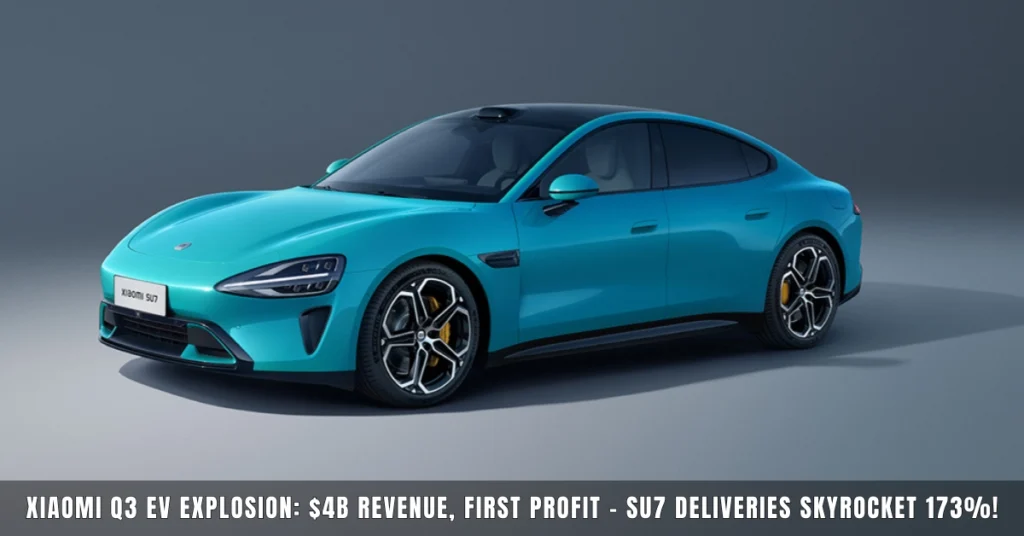
- EV Triumph: $3.98B revenue (RMB 28.3B, +37% QoQ); first positive operating income at $98M; 108,796 SU7 deliveries (+173% YoY).
- Smartphone Stability: ASP up to $149; India share dips to 7.8% in Q1 2025 (from 12.8% YoY), ranking #6.
- Network Expansion: 402 sales centers in 119 cities and 209 service sites in 125 cities as of Sep 30, 2025.
- Stock Dip: HK shares down 2.81% to HK$41 (YTD +18.2%); AIoT & new initiatives revenue +199.2% YoY.
- India Legacy: Entered 2014 online; #1 brand 2017–2022; sub-$200 demand fueled rise over Samsung.
Xiaomi’s Q3 Power Play: EVs & AI Flip to Profit as Revenue Roars 22%
Chinese tech behemoth Xiaomi has cemented its pivot from smartphones to smart ecosystems, unleashing blockbuster Q3 2025 results that underscore the electric vehicle (EV) arm’s breakout profitability. On November 18, 2025, the company unveiled revenue of $15.90 billion (RMB 113.1 billion), a robust 22.3% year-over-year leap and the fourth consecutive quarter eclipsing the $14 billion mark, as per its earnings release. Adjusted net profit swelled 80.9% to $1.59 billion, while IFRS figures more than doubled to $1.73 billion from $0.75 billion a year ago. Gross profit surged to $3.65 billion, pushing the margin to a stellar 22.9%, Xiaomi’s highest ever, fueled by premium pricing, supply chain tweaks, and the meteoric rise of its SU7 EV lineup.
This isn’t mere momentum; it’s a masterclass in diversification. Xiaomi’s “smart EV, AI, and new initiatives” segment exploded 199.2% YoY, with EVs alone clocking $3.98 billion in revenue, up from $2.90 billion in Q2 and $2.55 billion in Q1. For the first time, the automotive unit posted positive operating income of $98 million, validating CEO Lei Jun’s aggressive $10 billion R&D bet since 2021. Deliveries of the SU7 sedan series rocketed 173.43% YoY to 108,796 units, with a 32.59% QoQ bump, and the average selling price climbed to $36,580 thanks to hot demand for the upscale YU7 SUV variant. As of September 30, Xiaomi’s EV empire spanned 402 sales centers across 119 cities and 209 service facilities in 125 cities, outpacing rivals in buildout speed.
Smartphone Anchor Holds Firm Amid EV Spotlight
Xiaomi’s core smartphone business, which still commands over 50% of revenue, stayed resilient with an average selling price (ASP) nudging up to $149, a nod to premium pushes like the Xiaomi 15 series. Shipments held steady globally, but regional headwinds lingered: In India, where Xiaomi stormed in 2014 via online disruptor tactics and dethroned Samsung as #1 by 2017 (reigning through 2022 on sub-$200 hits), market share eroded to 7.8% in Q1 2025 from 12.8% YoY, a 42% shipment plunge that booted it to #6 overall. Still, the segment’s stability buffered EV ramp-up costs, with R&D expenses ballooning 52.1% YoY to RMB 9.1 billion across AI and mobility.
Profit Pivot: EVs & AI Turn Black Ink – What’s Driving the Surge?
The Q3 windfall spotlights Xiaomi’s ecosystem alchemy: EVs aren’t a side hustle; they’re the profit engine. The SU7’s urban NOA (navigation on autopilot) rollout in October 2025, tri-motor Ultra variant (1,548 PS, 350 km/h top speed, RMB 814,900 launch price), and doubled production shifts since June have crushed initial 76,000-unit targets, now eyeing 130,000 for the 2025 full year, up from 100,000 cumulative by November. Gross margins hit 25.5% in EVs (RMB 28.3B revenue), edging toward break-even ahead of forecasts via tax subsidies, scale, and efficiency.
Broader tailwinds? AIoT revenue ticked up 1.6%, but the real juice flows from “human x car x home” synergy—SU7 integrations with Xiaomi smart homes boosting cross-sells. Challenges persist: Memory chip costs squeeze smartphone margins (mitigated via price hikes), and capacity crunches delay SU7 orders. Yet, with Q4 deliveries projected at 144,000 units (November/December: 48K/50K), full-year EV shipments could hit 410,000—doubling YoY and claiming ~20% of total revenue.
Market Echo: Shares Dip, But Long-Term Bulls Charge
Investors greeted the news with a yawn—Hong Kong shares slipped 2.81% to HK$41 on November 18, despite an 18.2% YTD gain. Analysts chalk it up to lofty expectations (revenue beat LSEG consensus), but institutions like Huatai Securities see EVs ballooning to one-fifth of revenue by 2026. Xiaomi’s India playbook—from budget blitz to premium pivot—hints at global parallels: As EVs conquer China (SU7 pre-orders: 3,680 Ultras in 10 minutes), exports to Europe and beyond loom.
In sum, Q3 2025 cements Xiaomi’s rank as a tech titan in flux: From Mi phones to SU7 speed demons, profitability across EVs and AI signals a valuation rerate from gadgets to ecosystems. With $1B+ quarterly EV hauls on the horizon, Lei Jun’s vision isn’t just surviving the smartphone wars—it’s soaring above them.
Source: www.businessworld.in
Read more about EV Car News
Also Read
- MG Windsor Big Discounts Jan 2026: First-Ever Offers Make It Cheaper Than Launch Price
- JSW Motors To Enter Passenger Car Space In June With Rs 45 Lakh Plug-In Hybrid SUV

- Maruti Suzuki Second Car Plant Gujarat Investment: ₹4,960 Crore for 10 Lakh Unit Capacity

- India’s EV Sales Reach 2.3 Million Units in 2025, 8 Percent of New Vehicles: Strong Growth Led by Two-Wheelers
- VinFast Off to a Fast Start, Crosses 1k EV Sales in India: Milestone in Just Four Months

- What Happens To EV Battery After End-Of-Life?