Image Source: emeoutlookmag.com
eVTOL Vehicle Market Rank: 2025-2032 Growth Snapshot
- Market Surge: Valued at USD 50.05 billion in 2024, the eVTOL market is projected to reach USD 189.67 billion by 2032 at 18.12% CAGR.
- Core Drivers: Urban Air Mobility (UAM) demand, battery/motor innovations, aerospace-startup partnerships, and supportive regulations.
- Key Segments: Passenger air taxis lead; cargo and medical/emergency eVTOLs are rising; and multirotor & lift-plus-cruise designs dominate.
- Regional Leaders: North America tops with investments & regs; Europe innovates on sustainability; Asia Pacific eyes explosive urbanization-fueled growth.
- Top Players: Boeing, Lockheed Martin, Turkish Aerospace, IdeaForge, Israel Aerospace Industries, AeroVironment, Schiebel, Saab, Northrop Grumman, DJI, and Textron.
- Breakthroughs: Vertical Aerospace’s 1,000-mile VX4 hybrid; Joby Aviation’s Dubai delivery for 2026 air taxis; Volocopter-Airbus vertiport collab.
- Challenges: Certification hurdles, high capital costs, supply-chain bottlenecks, infrastructure gaps, public safety trust.
eVTOLs: The Dawn of Aerial Urban Revolution
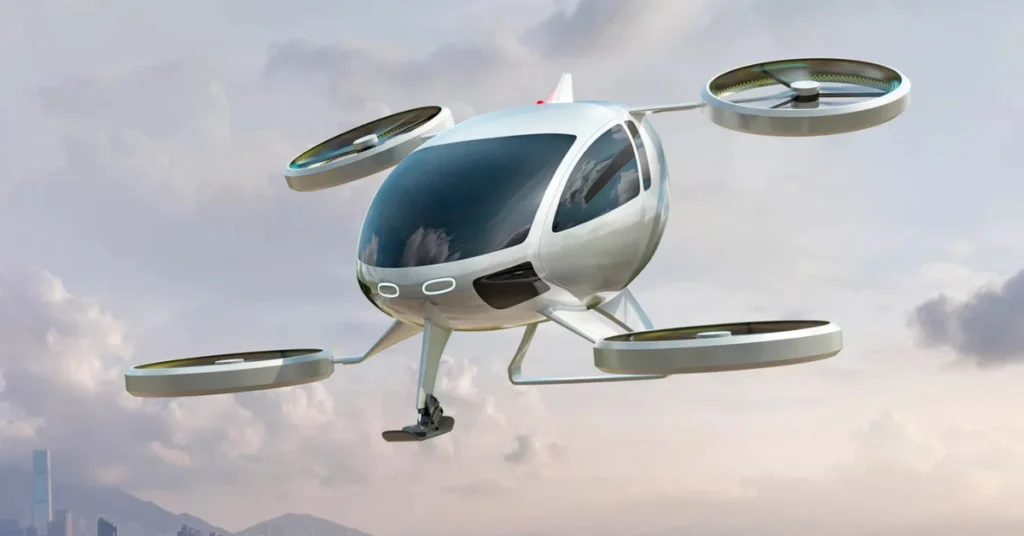
The electric vertical take-off and landing (eVTOL) vehicle market is blasting off into a transformative era, blending electric efficiency with vertical agility to redefine city skies. Valued at USD 50.05 billion in 2024, this sector is forecasted to soar to USD 189.67 billion by 2032, clocking a robust 18.12% CAGR from 2025 onward, per Introspective Market Research (IMR). No longer pie-in-the-sky dreams, eVTOLs—low-noise, zero-emission flyers—are tackling urban gridlock, slashing carbon footprints, and pioneering Urban Air Mobility (UAM). Backed by maturing batteries, regulatory green lights, and billion-dollar bets, these winged wonders are set to shuttle passengers, cargo, and medics above the fray.
Why eVTOLs Are Poised for Liftoff: Unpacking the Momentum
Urban Air Mobility Takes Flight
Skyrocketing city populations and choked roads are screaming for alternatives—enter eVTOL air taxis. Envision vertiports dotting rooftops, ferrying commuters from downtown to airports in minutes, not hours. Regulators are paving low-altitude corridors, turning sci-fi into scheduled shuttles.
Tech Leaps Fuel the Ascent
Breakneck advances in high-density batteries, slick electric motors, and featherweight composites are extending ranges, slashing charge times, and boosting safety. What was once a 20-minute hop is now eyeing 100+ miles per flight, making eVTOLs viable for daily dashes.
Powerhouse Partnerships Accelerate Progress
Aerospace titans like Boeing and Lockheed Martin are teaming with nimble startups such as IdeaForge and Latitude Engineering, fusing legacy know-how with fresh disruption. These alliances are fast-tracking prototypes to production lines.
Regulations Clear the Runway
From FAA nods in the U.S. to EASA frameworks in Europe, governments are crafting rules for safe, green skies. Incentives for emissions-free ops and vertiport builds are dismantling barriers, inviting operators to launch.
Diverse Missions Expand the Horizon
Passenger pods grab headlines, but cargo drones for last-mile logistics, air ambulances slicing through traffic for emergencies, and defense scouts are unlocking massive niches, multiplying the market’s appeal.
Expert Pulse: Mobility’s Makeover
“The eVTOL market is not just an aviation story—it’s a transformation of mobility itself,” asserts Dr. Anita Rao, Principal Consultant at IMR. “Our research indicates that the convergence of advanced battery technology, lightweight design, and regulatory clarity is finally enabling eVTOLs to transition from concept to commercial scale. The real inflection point will come when operators launch large-scale air taxi services, backed by infrastructure like vertiports, and supported by robust public-private partnerships.”
Regional Skies: Where the Action’s Heating Up
North America: The Launchpad Leader
With deep pockets and a powerhouse aerospace ecosystem, North America commands the roost. U.S. cities are mapping vertiports, while the FAA fast-tracks certifications—priming the pump for UAM dominance.
Europe: Sustainability’s Sky High
Battling congestion with an eco-focus, Europe leverages EU backing for air taxis and med-evac ops. Local innovators and stringent green regulations position it as a connectivity crossroads.
Asia Pacific: The High-Growth Hotspot
Urban megacities like Tokyo and Mumbai are urbanization’s frontlines, spurring government pushes and investments. This region’s rapid rollout could eclipse others in sheer scale.
Segment Breakdown: Applications, Tech, and Ops
By Application: Passenger Pods Pull Ahead
Air taxis for fixed-route hops combat urban woes, but cargo’s green last-mile edge, medical’s life-saving speed, and special missions’ tactical prowess are hot on their tails.
By Technology/Design: Batteries Buzz, Hybrids Hum
Pure battery-electric leads for urban zips, with hybrids extending horizons. Multirotors rule short hops; lift-plus-cruise and tilt-rotor gears up for cross-city cruises.
By Operation: Pilots Pave, Autonomy Awaits
Human-piloted fleets kick off for trust-building, but AI-driven autonomy looms to slash costs and scale swarms in megacities.
Game-Changers in the Cockpit: Recent Wins
- Vertical Aerospace rolls out a hybrid VX4, eyeing 1,000-mile treks for defense and logistics.
- Joby Aviation hands over its first production bird to Dubai, teeing up 2026 air taxi ops.
- Volocopter and Airbus sync on shared vertiports for seamless UAM flows.
- Horizon Aircraft‘s Cavorite X7 hybrid promises an ~800 km range for versatile missions.
Hurdles on the Horizon: Navigating Turbulence
Certification Crunch
Aviation watchdogs like the FAA and EASA are scripting eVTOL rulebooks—battery safety and autonomy proofs remain sticking points.
Cash Burn Blues
Sky-high R&D and infra costs are torching treasuries; Lilium’s woes spotlight the scramble for funding pre-launch.
Trust Takes Flight
Noise gripes, crash protocols, and robo-pilot jitters must ease for mass buy-in—demos are key.
Supply Snags
Rare battery chems and motor bottleneck builds; scaling chains is the next boss level.
Infra Imperative
Vetiports, chargers, and airspace weaves demand urban overhauls—a lagging ground game could ground dreams.
Energy Economics
E-prop savings shine, but battery wear, maintenance, and juice prices will dictate long-haul viability.
Visionary Vignette: SkyLink Metro—A Hypothetical Horizon
Picture a Southeast Asian smart city unleashing SkyLink Metro: Teaming with Archer or Volocopter, it erects three vertiports linking biz hubs, burbs, and bays. A 50-strong four-seater fleet handles rideshares and shuttles, juiced by solar-grid hybrids. Year one? Thousands of trips, 40% faster than roads, 60% greener than cabs. By year three: 200 birds, cargo/medical add-ons, easing jams and inequities in one aerial swoop.
Source: timestech.in
Read more about EV Car News
Also Read
- MG Windsor Big Discounts Jan 2026: First-Ever Offers Make It Cheaper Than Launch Price
- JSW Motors To Enter Passenger Car Space In June With Rs 45 Lakh Plug-In Hybrid SUV

- Maruti Suzuki Second Car Plant Gujarat Investment: ₹4,960 Crore for 10 Lakh Unit Capacity

- India’s EV Sales Reach 2.3 Million Units in 2025, 8 Percent of New Vehicles: Strong Growth Led by Two-Wheelers

- VinFast Off to a Fast Start, Crosses 1k EV Sales in India: Milestone in Just Four Months

- What Happens To EV Battery After End-Of-Life?