Overview
- Scheme Lapse: SPMEPC expired without applications despite Tesla tailoring; the government to reopen with tweaks.
- OEM Feedback Loop: Two-week window for input on DVA norms, penalties, and eligibility barriers.
- Investment Threshold: ₹4,150 Cr minimum, 25% DVA in 3 years, 50% in 5 years, bank guarantee.
- Import Incentives: 15% duty on $35K+ cars for committed OEMs; brownfield for locals with conditions.
- Tesla’s CBU Route: Entered via imports, no manufacturing interest yet; Hyundai, Kia, VW, and Toyota eyed.
- Revamp Drivers: Address strict rules and high barriers; aim to fund new plants via duty savings.
- EV Push: Supports 30% penetration by 2030 amid FAME-III.
India EV Manufacturing Scheme Revision: Govt Seeks Feedback to Attract Tesla & Global OEMs
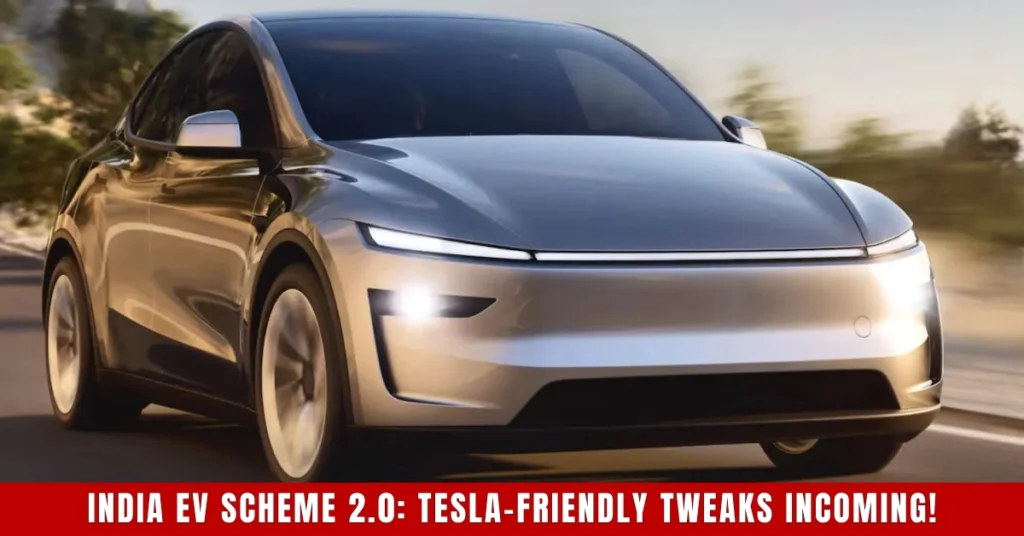
The Indian government is set to revise its Electric Passenger Car Manufacturing Scheme (SPMEPC) after it lapsed in October 2025 without a single application, despite being crafted to lure Tesla. Heavy Industries Minister HD Kumaraswamy announced a two-week feedback window for OEMs to suggest changes on domestic value addition (DVA) norms, penalties, and eligibility hurdles. The overhaul aims to make India a global EV hub, with potential duty cuts and relaxed rules to fund new plants via import savings.
Originally notified in March 2024 pre-elections, SPMEPC promised 15% duty on high-value imports ($35,000+) for ₹4,150 Cr investors achieving 25% DVA in 3 years and 50% in 5. But strict bank guarantees and brownfield restrictions deterred even interested parties like Hyundai, Kia, VW, and Toyota. Tesla opted for CBU imports, setting up showrooms sans manufacturing commitment.
SPMEPC Recap: Ambitious but Unclaimed
| Requirement | Details |
|---|---|
| Investment | Minimum ₹4,150 Cr ($500M) |
| DVA Targets | 25% in 3 years, 50% in 5 years |
| Guarantee | ₹4,150 Cr bank guarantee |
| Benefit | 15% duty on imports (vs 70–100%) |
| Brownfield | Allowed for locals with new EV line, demarcation |
Feedback Focus: Fixing the Barriers
OEMs flagged:
- High Entry: The ₹4,150 Cr threshold and guarantee are too steep.
- DVA Rigor: 25% in 3 years is unrealistic amid supply chain gaps.
- Penalties: Harsh for non-compliance.
- Eligibility: Greenfield bias; brownfield conditions rigid.
Government sources hint at duty concessions, phased DVA, and lower guarantees post-consultations.
Tesla’s Import Path: No Factory Yet
- CBU Entry: July 2025 showrooms in Mumbai/Delhi; 800+ orders by October.
- No Commitment: Despite SPMEPC sops, Tesla focuses on imports; local assembly talks are ongoing.
- Other Players: Hyundai/Kia/VW/Toyota expressed interest but held back.
EV Landscape: 30% by 2030 Hinges on Schemes
- Current: EVs 2% of sales; infrastructure gaps persist.
- FAME-III: ₹10,900 Cr for subsidies and chargers.
- SPMEPC Role: Could fund gigafactories and exports.
Conclusion: Scheme 2.0 to Spark EV Boom
India’s EV manufacturing scheme revision is a wake-up call to woo giants like Tesla. With two-week feedback, the govt eyes duty tweaks and norm relaxations to unlock ₹4,150 Cr plants and 15% import perks. As EVs hit 2% sales, SPMEPC’s revival could catapult India to 30% penetration by 2030—affordable, local, electric. The charge is on.
Source: auto.economictimes.indiatimes.com
Read more about EV Car News
Also Read
- MG Windsor Big Discounts Jan 2026: First-Ever Offers Make It Cheaper Than Launch Price
- JSW Motors To Enter Passenger Car Space In June With Rs 45 Lakh Plug-In Hybrid SUV
- Maruti Suzuki Second Car Plant Gujarat Investment: ₹4,960 Crore for 10 Lakh Unit Capacity
- India’s EV Sales Reach 2.3 Million Units in 2025, 8 Percent of New Vehicles: Strong Growth Led by Two-Wheelers
- VinFast Off to a Fast Start, Crosses 1k EV Sales in India: Milestone in Just Four Months
- What Happens To EV Battery After End-Of-Life?